
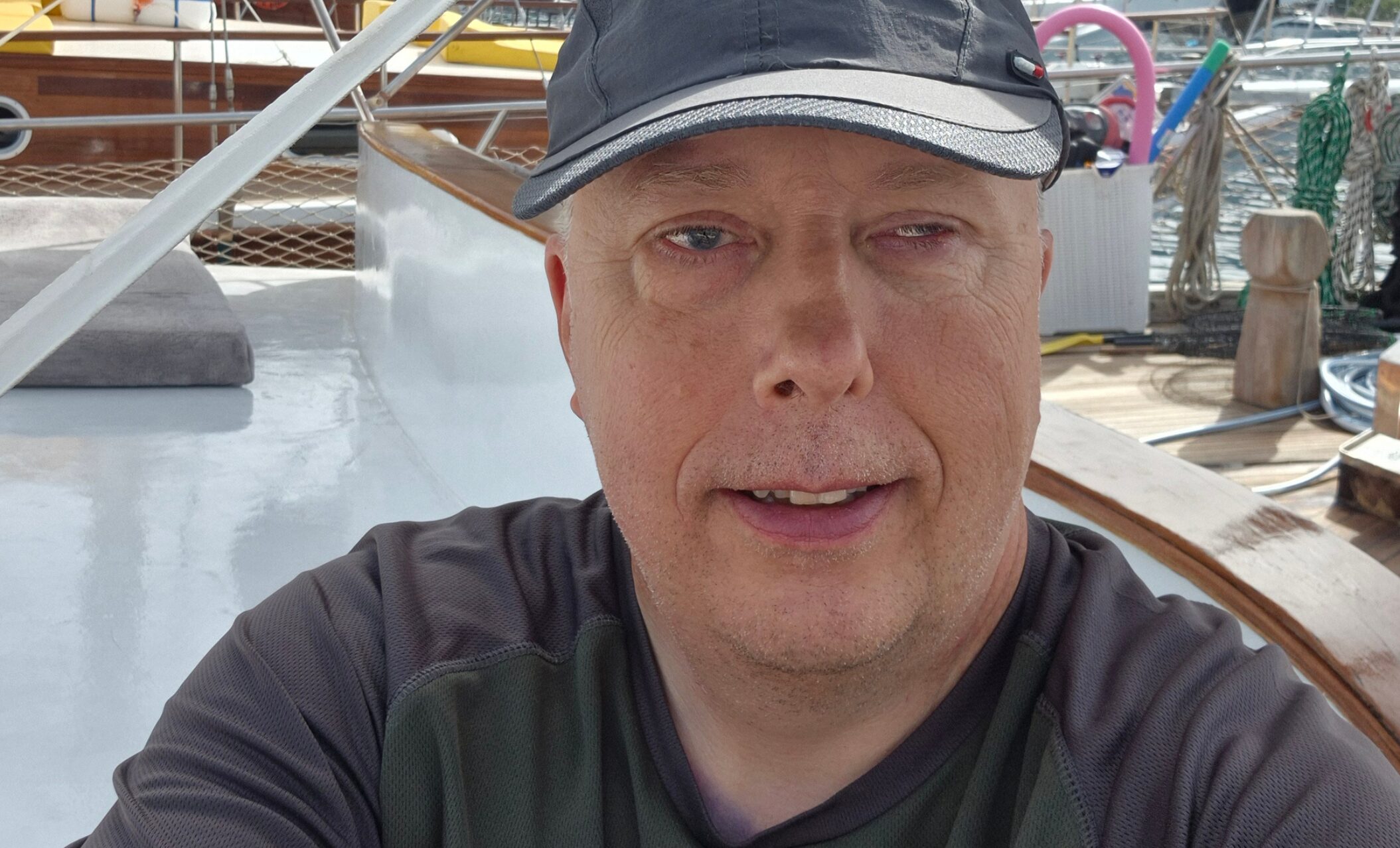
Richard Elkan, now 56, first experienced vision problems in 1990. Night vision became challenging and, even with contact lenses, he saw a halo effect around everything he looked at.
“I was very close to my grandfather who was, allegedly, blinded in the war. So I’d grown up knowing a lot about blindness and how it impacts someone’s life. But I never thought about it happening to me,” Richard recalls. “I was in my early twenties when everything started to change. I was training in the army at the time and started to realise I couldn’t see very well at night; I was walking into trees, and I thought, there’s something strange going on here.”
Doctors diagnosed Richard with corneal dystrophy, a rare genetic condition affecting his cornea, and glaucoma, which caused pressure from fluid build-up. It transpired that his grandfather in fact had the same condition, which Richard inherited.
After his diagnosis, Richard went through a number of procedures at Moorfields in London to regulate his eye fluid. The surgeries relieved the pressure, but ultimately, his sight continued to decline.
Over the next ten years Richard’s deteriorating vision meant he had to give up driving and change his career. His peripheral vision was fading which was particularly frightening.
“I started to seriously think ‘I’m going to lose my vision’ and the idea of having to completely depend on others made me really worried,” Richard says. “I felt safe and secure in my own space but I didn’t like going out, especially to crowded places.”
By 2014, things had gotten worse. Richard’s corneas had failed, causing blisters in his eyes and severe pain. He relied on a walking stick and his wife’s support. He had lost all vision in his left eye and was desperate for a solution that could restore what remained of his sight.
Richard was referred to the Southampton Eye Unit where he met Dr Parwez Hossain, a Consultant Ophthalmologist. Dr Hossain understood his condition and suggested a cornea transplant, which is a surgery that uses corneas from organ donors. However, there is problem: there aren’t enough healthy corneas for everyone who needs them. Many patients have to wait for two years to get the surgery they need. Eye banks in the UK, including the one in Southampton, are around 20% below the level needed to supply hospitals. Luckily for Richard, in 2015 he was able to undergo a successful cornea transplant that changed his life.
“I was lucky to get the transplant within four months. Dr Hossain helped speed up the process, and I’m truly grateful,” says Richard. “It was brilliant. I could see colours again, it felt like a second chance at life. I woke up every morning full of energy!”
But in 2020, Richard’s sight began to deteriorate again when his eyes began to reject the graft. He was in a lot of pain and his eyesight became very poor. Dr Hossain referred Richard for a second corneal graft surgery, although this time he did have a year-long wait.
Although his peripheral vision remains diminished, the transplant restored his central vision, allowing Richard to regain some of his day-to-day life.
“I’m cherishing every moment. I’m blessed to still be able to enjoy reading and theatre,” Richard says, aware that without this surgery his quality of life would be more severely impacted.
“Richard’s story shows us the transformation that a corneal transplant can make,” says Dr Parwez Hossain. “You go from a life which is like a dusty fog; you can’t make out any detail. Then you get the chance to see again. However, like in Richard’s case, a graft might only last for a number of years and then you need to have another. The big problem is that we’re running out of corneal tissue to transplant. This means patients can wait a long time for surgery in discomfort, or not even be offered the surgery at all.”
Dr Hossain is working with colleagues in the University’s Optoelectronics Research Centre to develop a new laser technology to address this issue. This advanced laser can split a cornea into two or three pieces with high precision, making the most of a single donor tissue. With this technology one donor can potentially help up to six patients to regain their sight.
This innovation offers hope for people like Richard, who are unable to fully enjoy all that life offers while they wait for treatment. His daughters share the same condition but have been unaffected so far; new developments like this offer an enormous amount of hope for the future.
Richard remains eternally grateful for his restored vision and feels that he is indebted to Southampton’s Eye Unit and everyone involved in his treatment. As an active advocate with NHS Blood and Transplant, he aims to raise awareness about the critical importance of organ donation.


