
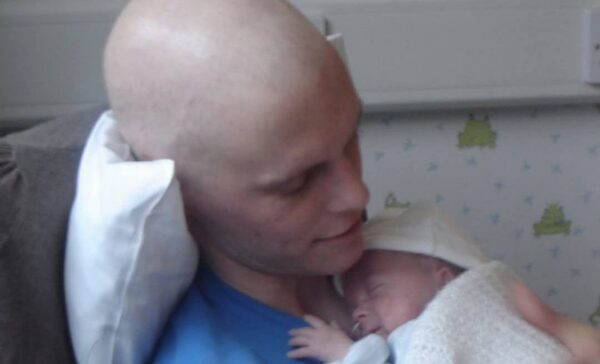
Over a three-year period, Craig and his wife, Dawn, endured what most couples couldn’t imagine in a lifetime.
Dawn faced a devastating cervical cancer diagnosis, which led to a miscarriage. The glimmer of hope was that, after Dawn underwent a specialist surgery, she fell pregnant through IVF.
The couple were delighted, but they were soon faced with more shocking news.
Craig became unwell a little while after discovering that Dawn was pregnant. Being an instructor working for the Army and now a fitness coach and gym owner, meant Craig was a very fit man. He was playing in a three-day football tournament, something he would normally breeze through. But by the final day, he could barely get out of bed.
“There are certain levels of fatigue that I’ve been used to, but this was like nothing I’d ever felt. Then came a persistent cough and night sweats. I knew something wasn’t right.”
His GP found lumps near his clavicle, something Craig had never noticed before. He was sent for an X-ray, which revealed four shadows under his sternum. Blood and subsequent bone marrow tests confirmed Hodgkin Lymphoma.
Under the care of Peter Johnson, Professor of Medical Oncology at the University of Southampton, he began chemotherapy at University Hospital Southampton. “The treatment was brutal,” he remembers. “I lost a lot of weight; I looked like Morph at one point. The sickness and the exhaustion were intense. It was pretty horrific at times.”
Then one day, after stopping his anti-sickness medication too soon, Craig became severely ill and was rushed to the hospital. That same night, Dawn went into premature labour. And at 27 weeks, the baby came early.
At just 2lbs 2oz, baby Alfie was in the NICU at the same time his father was severely unwell in hospital, preventing him from being at the birth. Craig describes not being there as his “biggest regret.”
“It was the first time I had ever been blue-lighted to the hospital. I was so ill, I didn’t know what was happening. I don’t know whether it was stress, but Dawn went into labour and had to have an emergency C-Section.
“I wasn’t there when my son was born,” Craig says. “I couldn’t see him for about four days. That’s my biggest regret, that I couldn’t be there for Dawn or our baby. It was touch-and-go for the first few weeks, but he’s a fighter. Now he’s 14, starting his GCSEs. It’s amazing, we’re all still here.”
Craig travelled to Southampton for regular chemotherapy treatment, which lasted for six months. He went into remission and remembers the joy he felt when being given the news.
“I remember thinking to myself that I was sure it was working because I felt so much better than in the earlier appointments,” he recalls. “I just felt an enormous sense of relief.”
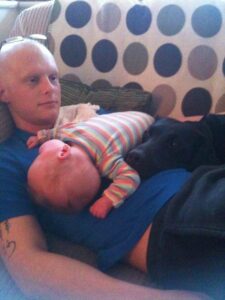
Craig’s treatment also allowed him to be part of something bigger. He took part in the RATHL trial, led by Professor Johnson in Southampton, which tested whether PET scans (a test that uses a small amount of radiation to scan inside your body) could guide treatment decisions for Hodgkin lymphoma. Hodgkin lymphoma is treated with either chemotherapy, radiotherapy or a combination of both. Most people in the UK have a combination of chemotherapy drugs known as ABVD (adriamycin, bleomycin, vinblastine and dacarbazine). The trial found that patients whose scans were negative (which meant that ABVD had worked well) could safely stop taking one of the drugs, reducing lung damage and side effects, without affecting survival rates. Craig was able to stop taking this drug, something that he feels has helped him in his career as a PT but also a competitive athlete.
Craig says: “When I was asked, it was a no-brainer. Research is vital. Without it, we don’t move forward. I’ve got the privilege of living the life I have now because of people who came before me and took part in trials. Why wouldn’t I want to give that chance to others?
“I’m glad I took part in the trial. I believe that removing the drug from my treatment meant so much to my lung function improving and what I’ve been able to go on to achieve professionally and personally. I’ve competed in both Power and Weightlifting and been lucky enough to qualify and compete in English, British, European and World Championships.”
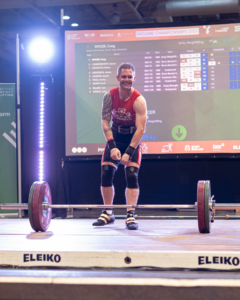
For Craig, one of the hardest lessons was allowing other people to help him. “I admit that I am the rock, the one who likes to do everything for everyone. Admitting I needed help was the hardest part. Once I accepted it, things became a little easier, but it took time.”
Now approaching 41, Craig says he owes a lot to the doctors, nurses, and researchers. “The whole timeframe from when Dawn was diagnosed to my recovery, including when Alfie was born, was about three years. It was hell for three years. But the team were absolutely amazing. I wouldn’t be here without them.”


